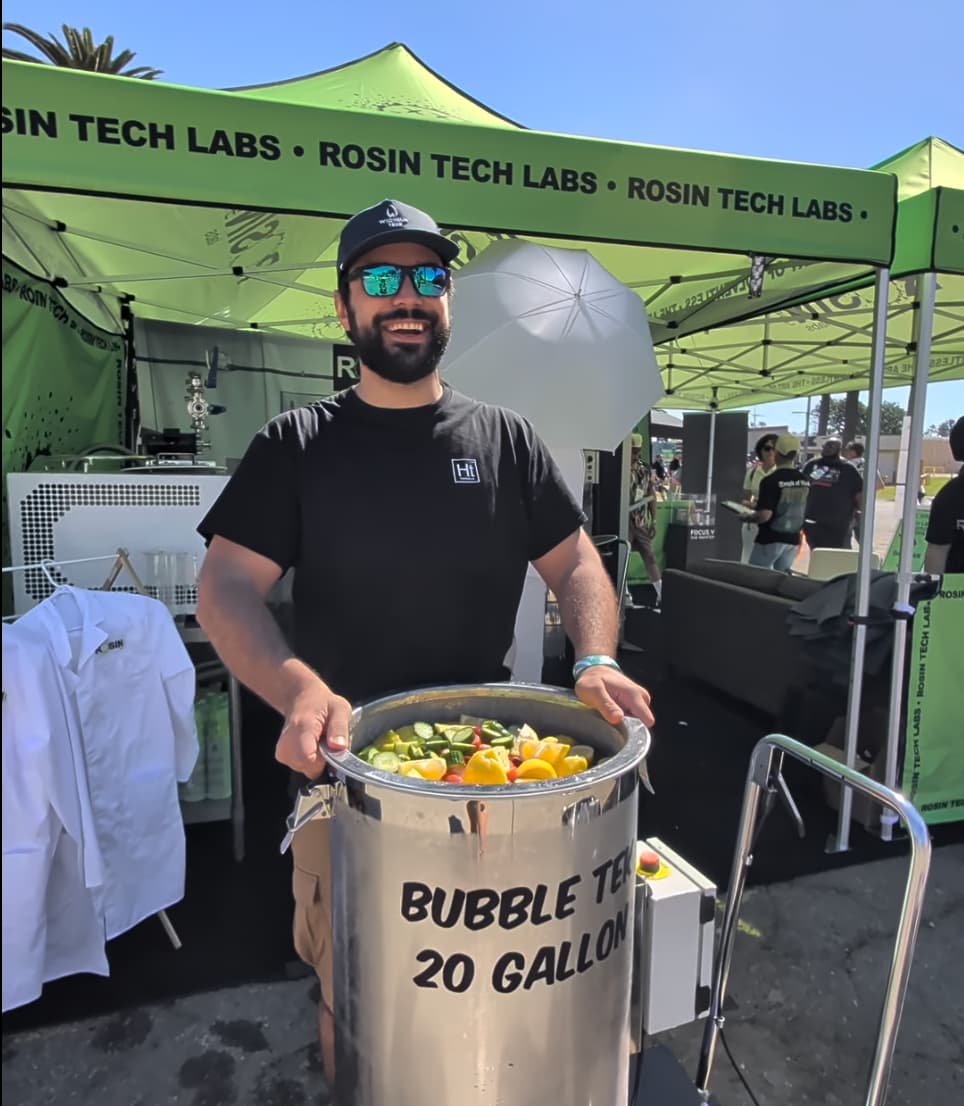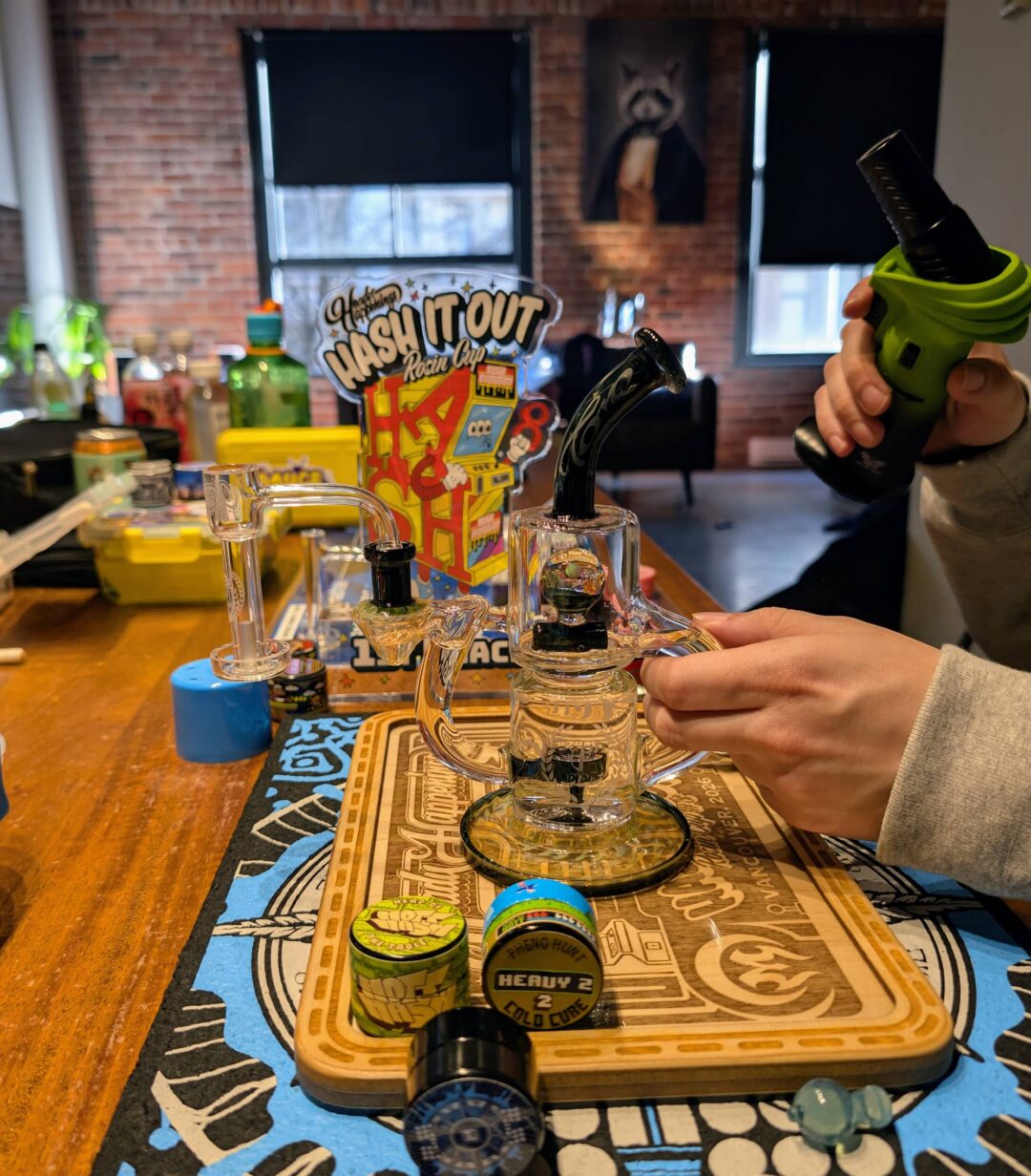



This experiment was conducted to evaluate how hop lupulin glands behave when subjected to a standard cannabis-style ice-water mechanical separation workflow in a Hashtek 65A agitator. Although cannabis and hops differ chemically—most notably, cannabis produces cannabinoids while hops do not—the two plants share a structural similarity: both store their meaningful aromatic and resinous compounds inside glandular trichomes.
In cannabis, these are capitate-stalked trichomes.
In hops, they are lupulin glands, located at the base of the bracteoles inside the hop cone.
The goals of this experiment were to determine:
- Whether lupulin glands can be mechanically detached using solventless extraction techniques.
- How their particle-size behavior compares to typical cannabis trichome heads.
- Whether pressing hop hash results in measurable concentration of hop resins and essential oils.
- What the terpene profiles look like in both pre-press and post-press material according to High North laboratory testing.
Background: Lupulin Glands
Lupulin glands are yellow, granular peltate glandular trichomes that synthesize and store:
- Hop α- and β-resins
- Essential oils (including myrcene, humulene, caryophyllene)
- Additional secondary metabolites such as polyphenolic compounds
The chemical intensity of hops strongly correlates with the number and total volume of lupulin glands present in the cone. These glands contain the majority of the hop’s bitter acids and key volatiles responsible for aroma and flavor.
Lupulin glands are anatomically comparable to cannabis glandular trichomes in that both consist of a secretory cavity and produce similar classes of terpenoid compounds.
Lupulin Gland Size vs. Cannabis Trichome Head Size
Published hop-processing literature frequently describes lupulin separation using coarse screening methods (on the order of several hundred micrometers) when dealing with dry, milled hop cones. This suggests that intact lupulin glands and their aggregates behave as relatively large particles.
Cannabis trichome heads, in contrast, are well-documented in the ~50–100 µm range depending on genetics and maturity.
Based on these references, our initial assumption was that hop lupulin glands would be substantially larger than cannabis trichome heads when hydrated. To test this, we prepared:
- Custom 160 – 400 µm filter bags intended as the primary lupulin collection screen
- A 45 µm bag placed last in the stack as a safety screen
This setup allowed us to observe real-world performance instead of relying solely on dry-processing size expectations.
Agitation Method: Hashtek 65A Workflow
Hops were loaded into the Hashtek 65A and processed using a standard solventless-extraction ice-water workflow, including:
- Cold water fill
- Low-to-moderate agitation cycles
- Recirculation
- Sequential filtration through the full bag stack
The objective was not to produce a culinary or brewing product, but to observe:
- Gland detachment efficiency
- Apparent particle-size distribution
- Resin behavior under mechanical agitation
- Filtration performance across bag sizes
Filtration Results: Dominance of the 45 µm Fraction
Contrary to expectations from the literature on dry hop milling and sieving:
The 45 µm bag captured the highest mass of usable resin.
The 400 µm bag captured negligible material.
Several hypotheses may explain this outcome:
- Hydrated lupulin glands likely fracture during agitation.
Water-soaked lupulin glands may be more fragile than dry ones and may break into smaller fragments. - Associated vegetable tissue breaks down in water.
The bracteole tissue normally surrounding lupulin breaks apart, reducing the effective particle size of the material. - Hydrated lupulin moves differently than dry lupulin.
Particle behavior under turbulent cold-water extraction does not match dry-sieving behavior, leading to smaller effective fractions.
The practical takeaway:
Even if lupulin glands are large in their dry state, solventless extraction is capturing the hop resin in the sub-100 µm range, similar to cannabis.
COA Results: Hop Hash (Pre-Press)
High North analyzed the hop hash (Lot HTHH01).
Cannabinoids
All cannabinoids were none detected (0.000%), consistent with hop biology and confirming no cannabis contamination.
Hop Hash COA
Terpenes (wt%)
- β-Myrcene — 0.5772%
- α-Humulene — 0.1056%
- trans-Caryophyllene — 0.0623%
Hop Hash COA
Total quantified terpenes: 0.745%
Hop Hash COA
These values align with established hop essential-oil profiles, where myrcene, humulene, and caryophyllene are major contributors to hop aroma.
COA Results: Hop Hash Rosin (Post-Press)
The pressed hop hash rosin (Lot HTHR01) exhibited substantial terpene concentration increases.
Terpenes (wt%) after pressing
- β-Myrcene — 2.4580%
- α-Humulene — 0.7759%
- trans-Caryophyllene — 0.4128%
Hop Rosin COA
Total quantified terpenes: 3.890%
Hop Rosin COA
This represents roughly a fivefold increase in total terpene content compared to the unpressed hop hash.
This is the same general principle seen in cannabis resin preparation:
- Mechanical separation yields a particulate resin fraction.
- Pressing consolidates that resin into an oil phase, enriching volatile compounds.
Although hops do not produce cannabinoids, their essential oils respond predictably to heat and pressure.
Interpretation and Comparative Notes
1. Lupulin glands are compatible with ice-water mechanical separation.
They detach and can be collected using solventless extraction methods.
2. Hydrated lupulin behaves differently than expected from dry milling literature.
The dominance of the 45 µm fraction indicates that most usable resin falls into particle sizes comparable to cannabis trichome heads.
3. Pressing significantly concentrates hop oils.
The ~5× increase in terpene density confirms that hop resin responds to pressing similarly to other plant oil-resin systems.
4. Shared terpenes explain aromatic similarities between hops and cannabis.
Myrcene, humulene and caryophyllene are major constituents of both plants’ glandular trichomes, contributing to overlapping sensory profiles.
Culinary Experiment: Hop Compound Butter
As a secondary experiment, we prepared a hop-infused compound butter using the resin collected during this wash. The goal was to evaluate how hop resin behaves in a fat-based culinary application, similar to how cannabis resin is commonly used.
The butter was prepared using standard infusion techniques and served over grilled steaks. Although the aroma was initially promising, the flavor was extremely bitter—to the point where it noticeably diminished the quality of the dish. This outcome is consistent with the chemical profile of hops: the α- and β-acids present in lupulin are responsible for the bitterness in beer and, without a balancing component, dominate the palate in food.
If such a preparation were to be optimized, it would almost certainly require a sweet or otherwise balancing element, analogous to how hops in brewing are used to offset the natural sweetness of wort. Additionally, hop resin is extremely potent in flavor, and any culinary use would need to be done sparingly.
Although the compound butter was not successful as prepared, this experiment did indicate potential applications in other product types. Sweet formats—such as hop-flavored gummies—were identified as a more suitable direction due to their ability to balance bitterness. Several individuals also noted that hops may carry mild therapeutic or calming properties, and while this is anecdotal, it could justify further controlled exploration in edible formulations.
Conclusion
This experiment demonstrates that:
- Lupulin glands can be separated using standard solventless extraction techniques, including ice-water agitation.
- Their hydrated particle behavior results in efficient capture at 45 µm, not the larger screens suggested by dry-processing literature.
- Pressing hop hash yields a predictable and significant increase in terpene concentration.
- The resulting chemical data helps explain why certain hop-forward beers share notable aromatic similarities with cannabis.
Further work could include:
- Comparing fresh vs. pelletized hops
- Testing multiple hop cultivars
- Microscopy of fractured lupulin glands pre- and post-agitation
- Bag-size optimization specific to hop processing